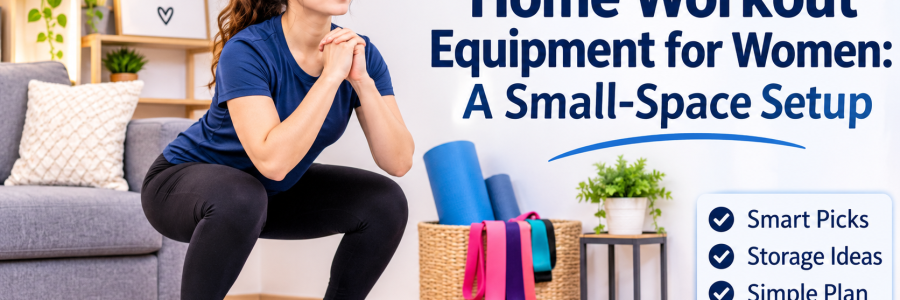
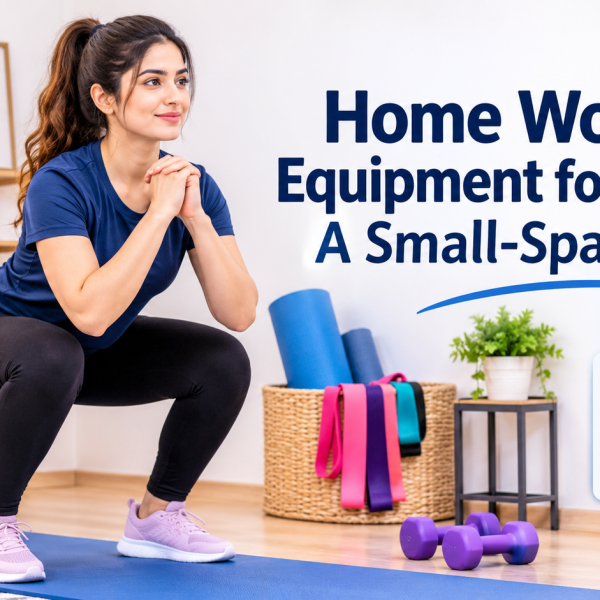
Consider a one-bedroom apartment on a Tuesday night. The couch is opposite the TV, the desk fits in the corner and the space left on the floor is just like the size of a bath towel. You wish to train at home. But where would a bench even go? Here’s the good news. You don’t need a bigger place. You need a plan that fits the one you’ve got.
That’s what this guide to home workout equipment for women is about: what to keep, where to tuck it, and how to get a lot out of a little gear.
This is what the guide on home workout equipment for women is all about – what to keep, where to store it, and how to get the most from minimal equipment.
Measure first; shop later.
Find your place before purchasing home exercise equipment for women. Place yourself where you will be exercising, stretch your hands to the sides, and rotate. Do you hit anything? If so, nudge the coffee table. Plenty of people only need a clear strip about as long as a yoga mat, with an arm’s reach on each side. That is just my personal rule of thumb and not an exact figure.
Next consider your neighbors. Exercising by dropping weight and jumping is not very friendly for your downstairs neighbors, hence, the need for quiet equipment in an apartment.
What Mayo Clinic says about starting out
Mayo Clinic has a short page on starting strength training, and its advice is refreshingly plain. Start light, then gradually increase. Get warmed up for 5-10 minutes through cardio exercises. Pick a weight that will exhaust your muscles in 12-15 repetitions, and repeat twice per week. Don’t train one muscle group for two consecutive days. The options include free weights, resistance machines, resistance bands, and bodyweight, while the recommendation includes “Stop when it hurts.”
None of that needs a big room. For anyone shopping for home workout equipment for women who live in small places, that’s a relief.
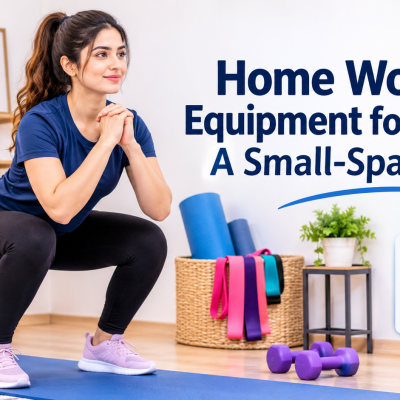
A kit of three
If I had to outfit a studio apartment, I’d start with three things. This comes from general fitness knowledge, so treat it as my opinion.
The first is a mat.It establishes your area and prevents your knees and wrists from the wear and tear of a hard floor. It is easy to keep folded behind a door or underneath the couch. The travel style mats are light and compact while the other type has more padding but occupies more space.
The second item to have is a set of resistance bands. These items have zero weight and can easily be accommodated in a shoe box. However, they can give you a workout for your legs, back, shoulders and arms. If possible, you should have several sets with different strength since your legs can take more than the shoulders. Test each set by giving it a gentle pull and checking whether there are any cuts or tears.
The third item is a set of dumbbells and here the space comes into play. Fixed pairs are simple, but you’ll need a new pair every time you get stronger. Adjustable sets cover many weights in one footprint, though they cost more and have moving parts. I haven’t priced either one, so compare for yourself.
Those three are enough to work out your legs, back, chest, shoulders, arms, and abs. A solid chair that you have lying around can replace a bench.
Stuff you already own
You may have more home workout equipment for women than you think. A chair handle supports sit-to-stands and supported moves. A wall handles push-upsA backpack filled with some books will suffice if it is well-balanced and easy to hold. These are personal thoughts, not tried-and-tested products, so it is essential that whatever you choose must be stable. Anything that can sway, slide, or tip, such as a rolling office chair, is not recommended.
If you prefer gentler exercises that only involve a chair and a wall, check out our beginner-level joint workouts from the comfort of your home.
Where it all lives
Gear that’s hard to reach doesn’t get used. Gear that’s always in your face makes the room feel messy. Moderation is key, which explains why storing the exercise gear at home is so crucial for women with small houses who work out at home. A basket by the sofa could store bands and a towel. Dumbbells could go into a bag under the bed, but since they are heavy, make sure to take them out gently, bending your knees when lifting.
When you need to use a door with bands, study the directions for the door anchor before you start. The door needs to be closed and locked, and there is nothing in that system that could swing loose. If anything seems unstable, avoid it.
Keeping the peace with the neighbors
A yoga mat rarely bothers anyone. A thud does. Put a mat under your weights and lower them to the floor instead of letting go. Bands and bodyweight moves are the quietest options by far. I’d save jumping for the day you know your floor can take it.
A simple week
According to the page of the CDC concerning adding physical activity as an adult, it is important to spend 150 minutes on a moderate level of physical activity per week and to make two days of muscle strengthening activities. This information I got from the same site earlier during my work on this project and now I am unable to get there. In no way you should aim at reaching those numbers in week one.
So, here is one of the options, which is mine. Choose two days a week for making strength exercises and put a rest day in between them. Warm-up a bit with a march in place and do several exercises such as chair squats, resistance band rows, wall push-ups and rest after each round. Do walking or stretching on the other days. In case everything is done successfully during several weeks, add some weight or extra repetition. Mayo’s rest advice fits nicely here, since you don’t need to train every day.
Check with a doctor if
There are some instances where you will need to have a professional’s approval before embarking on the training session, including cases of pregnancy, having recently given birth, surgery, cardiac or joint issues, or any continuous pain. I cannot determine what is good for your body, but you should seek the advice of a physician or physiotherapist. Should you feel any chest pains or become dizzy during the exercise, then you should discontinue.
Where people trip up
In the case of home gym equipment for women, the largest small space blunder is getting big equipment initially. Other blunders are keeping all the stuff at a place where you cannot get at it, using furniture that is not stable, opting for weights which are too heavy, and neglecting warm up.
Making it Stick
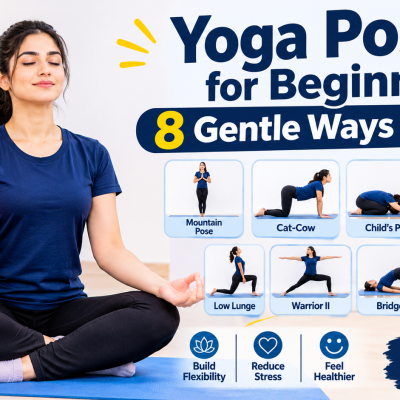
Keep your mat in such a place that it can be spread in ten seconds. Select a fixed time, maybe after work. And if you want to add something extra on off days, yoga poses guide will work great along with the strength training program.
Your next step
Clear your patch of floor. Try one move with nothing in your hands, like a chair squat or a wall push-up. If it felt okay, buy one thing from the kit of three and use it for two weeks before you add anything else.
For more ideas, browse our Home Workouts section. The best home workout equipment for women is whatever fits your room, suits your body, and actually gets used, so start small and let your space guide you.
FAQ
What home workout equipment for women works best in a small apartment?
These include a mat, some resistance bands, and dumbbells and these are all kept in a closet.
Is it possible to exercise at home without equipment?
Yes. There are chair squats and wall pushups that are very gentle. According to the Mayo Clinic, body weight is acceptable.
What are tips for storing home exercise equipment for women in a small area?
A basket, a hook, and space under the bed can be used. Place heavy objects close to the floor.
Do resistance bands work well for strength exercises?
They can work on many muscles, and according to the Mayo Clinic, they are acceptable. Most people later add dumbbells for increased difficulty.
What are some ways of having silent workouts?
Resistance bands, body weight, putting mats underneath the weights, and placing weights quietly are the ways.