Marcus ended up canceling his membership to the gym two years ago, when his daughter was born. With six o’clock feedings in the morning and work until late at night, traveling seemed like a distant reality. He believed his chest muscles would just continue to get smaller. It didn’t. He learned how to build chest muscles at home using nothing but his own bodyweight and, oddly enough, a kitchen chair. A year and a half later, he looked better than he had at the gym.
And that is the entire guide to how to build chest muscles at home. No equipment necessary, no gym membership. Just correct exercise, an ability to increase difficulty, and enough patience to get through that second week when you’ll be tempted to give up.
Why You Don’t Need a Gym to Build Your Chest
Most guides on how to build chest muscles at home talk like everyone has a bench press in the garage. Fine if you do. There are plenty of individuals who cannot, and that is due to either money, time, or just plain laziness to wait for a machine at 7 p.m.
These are the things that are often left out of all of these guides: your chest is developed through resistance, not a barbell. Your bodyweight is already a real load. A push-up puts a big chunk of your weight on your chest, and changing your hand position, your foot height, or how slowly you move makes it harder without adding a single plate. Push-ups aren’t a consolation prize, either—the CDC lists them as a legitimate way for adults to train major muscles, chest included.
The Push-Up Is Your Foundation
If you only ever learn one move, learn the push-up well. It’s not something you outgrow once you get “good” at it. You just keep making it harder for years.
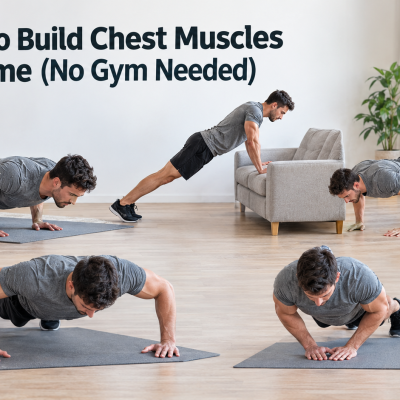
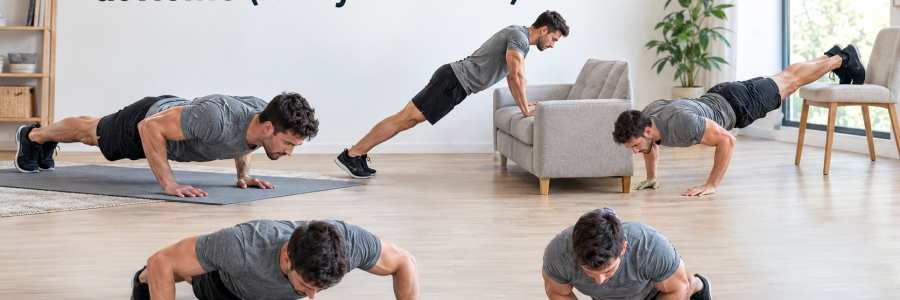
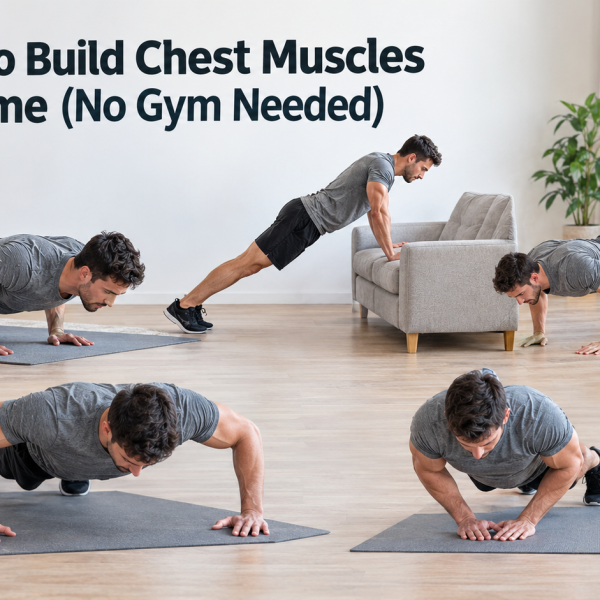
Standard push-up. With your hands slightly wider than your shoulder width, your body in a straight line from head to toe, your chest approaching the ground, and then driving it back up. This is usually done too fast. Go slow, spend two whole seconds going down, and you will experience this by rep number six.
Incline push-up. With your hands resting on a couch, table, or stairs, and your body inclined at an angle. Eases pressure from the chest and is a good starting place if a regular push-up is too difficult for you.
Decline push-up. Your feet elevated on a chair or step, with your hands planted on the ground. Places more stress on your upper chest and shoulders, which makes it a difficult exercise for the first time you do it, despite regular push-ups being easy.
Wide-grip push-up.Hands set wider than shoulder width. Stretches the chest more through the movement and leans on the outer chest a bit harder.
Diamond push-up. Hands together under your chest, thumbs and fingers touching. Shifts the load toward your inner chest and triceps. It’s tough even for someone who can already knock out twenty regular push-ups.
Work through these in that order over a few months, and you end up with a home chest workout that scales with you, with no equipment required.
Other Moves Worth Adding
Push-ups will serve you well, but a few extra exercises will complete your routine.
Chair dips. Sit on the edge of a strong chair, place hands on either side of your hips, and move your feet forward. Lower yourself to the floor using your elbows, and raise yourself again. Train your triceps and the lower part of your chest, and go perfectly with push-ups on the same day.
Pike push-ups. Assume the downward-dog position first, raise your hips high, then lower your head towards the floor and push back. Targets your upper chest and shoulder area—an area that is often neglected in home training.
Explosive push-ups. After you master the classic version, go for plyometric push-ups, when your hands get off the floor. Adds explosiveness on top of strength you have.
Resistance band chest press. If you own even a cheap set of bands, anchor one behind you and press forward at chest height. Gives you adjustable resistance without weights—worth the ten dollars once bodyweight alone stops being a challenge.
Warm Up First
Neglecting to do a warm-up seems perfectly safe until your shoulder starts to hurt in the third week. Muscles that are cold are not as flexible, and your chest, shoulders, and elbows work in such coordination that a tight shoulder can lead to a sore chest without realizing.
Ten minutes of stretching is unnecessary. Two or three is plenty. Start with arm circles, small at first, then bigger, both directions. Add a few slow shoulder rolls and ten to fifteen incline push-ups done slowly, well below your normal effort, just to get blood moving.If your shoulders are stiff, do a doorway chest stretch. Put your forearm against the door jamb, and move your body forward slightly.
This small warm-up habit is part of what makes how to build chest muscles at home actually sustainable. The entire exercise takes less time than choosing a TV program. Do it anyway.
How Progress Works Without Weights
It is not that pushups cease to be effective; rather, people become “stuck” with their pushups because they never change their routine in any way. Muscle tissue grows when it is challenged slightly above its capacity. With weights, this is simple; just add five pounds. Without weights, you’ve got four dials instead—change the move (standard to decline, say), slow down, add reps, or cut your rest time. Move one dial at a time. Stuck at 15 push-ups? Don’t jump straight to the hardest version. Try a slower three-second lower first and let your strength catch up before switching the move itself.
It’s not a secret technique. It’s boring, steady progress on moves you already know—which is basically the whole answer to getting a bigger chest without a gym.
How to Build a Bigger Chest Without Weights
Size and strength aren’t the same goal, even though people treat them like they are. Strength comes fast once you’re consistent. Size takes longer and asks for a bit more attention to how you train, not just how often.
Two things matter most here: time under tension and total volume.Moving more slowly, particularly on the way down, makes sure that your pectorals work longer on each repetition compared to moving fast. When we talk about volume, we mean the number of repetitions during the week, so doing five sets of eight repetitions is always better than two sets of eight.
Rest matters too. Cutting rest between sets to 30 or 45 seconds adds a different kind of stress that pushes growth once straight reps stop doing much. None of this needs a single home chest workout for beginners—piece of equipment, just attention to details most people skip.
A Sample Weekly Plan
Chest training should be done twice or thrice per week with at least a day off between workouts because muscles build during recovery, not during workout, and this is the area where beginners fail.
Day 1: Normal push-ups – 4 sets of near-failure. Chair dips – 3 sets of 10–15. Pike push-ups – 3 sets of 8–12.
Day 2 (day off or light cardio): Walk, stretch and have an easy day. Let your chest actually recover instead of just sitting there sore.
Day 3: Wide-grip push-ups, 4 sets close to failure. Decline push-ups, 3 sets of 8–12. Diamond push-ups, 3 sets of 6–10.
Add a third training day once you’re recovering well between two, and work in the plyometric or band moves as you get stronger. It’s not the only way to structure a week, but it’s a solid place to start.
Food and Sleep Matter More Than People Think
There are instances where you will be working out perfectly fine and yet your body will still not show any sign of growth. Protein is the nutrient that repairs and builds muscles, and for many adults, having protein in small amounts in various meals is better than taking all the protein in one sitting as the National Institute of Health says.
Protein powder is not necessary, and there is no need for a set meal plan as long as you eat eggs, chicken, beans, Greek yoghurt, and fish. In case of any difficulty when planning your meals amidst a new workout program, check out some of the meal prepping tips for beginners that we have provided.
Sleep matters just as much, maybe more. Most muscle repair happens while you’re asleep, which is a big reason two people doing identical workouts can get very different results depending on how well they rest. Sleep is the unglamorous half of the plan, and it’s the half most people skip.
Tracking Progress Without a Gym’s Equipment
Since there are no weight plates around that will tell you precisely how much you are lifting, it will be very tempting to feel stagnant even though you are actually making some progress. Take notes on what you are doing by simply logging the movement, number of sets and repetitions performed as well as how the final set felt.
Do this every few weeks and if you find yourself doing more push-ups or performing movements that were difficult at first are now easier, then you are making progress regardless of your reflection. Gains usually show up in numbers before they do in reflections.
Take videos of your push-up form every few weeks too because it will serve as your measuring stick especially since you don’t have any equipment around to gauge your progress against.
Common Mistakes That Slow You Down
Doing the same push-up version forever. Your chest adapts fast. If a move stopped feeling hard three weeks ago, it’s barely doing anything now.
Skipping the slow part on the way down. Bouncing at the bottom cuts the time your muscle spends under load, and that time is a big part of what actually builds it.
Training chest every single day. More isn’t automatically better. Muscles need roughly 48 hours to recover before you hit them again. Skip that and you just stack tiredness on top of tiredness with nothing to show for it.
Ignoring the rest of your body. A chest that grows without matching back and shoulder work will pull your posture forward over time. Balance push moves with some kind of pulling work—even the basics from our guide on how to build muscle at home cover your back and legs too.
Expecting fast results. Visible chest growth from bodyweight training usually takes 8 to 12 weeks of steady work before it shows in the mirror. That’s normal, not a sign something’s wrong.
Marcus didn’t notice a change in month one. By month three, his shirts fit differently. That gap between starting and seeing it is exactly where most people quit—right before it starts to work.
Frequently Asked Questions
Can you really build chest muscle without weights?
Yes. Bodyweight training does provide a method for building muscles without weights. Push-ups, position variations, timing, and repetitions all lead to building your chest.
How long does it take to see chest growth at home?
It may take as little as 8 weeks for some people, but depending on factors such as the frequency of training and the diet, every individual is different in terms of physical development.
Do I need resistance bands to build chest muscles at home?
No, though they help once bodyweight alone stops feeling hard. Push-up variations can carry you a long way before bands become worth buying.
How many push-ups a day should I do to build chest muscle?
There’s no magic number. Training close to your limit two to three times a week with rest days between beats, doing a fixed count every day with no changes.
Is it possible to get a bigger chest without a bench press?
Yes. The bench press is one tool, not the only one. Decline and pike push-up variations can hit the same parts of your chest that an incline or flat bench would.