
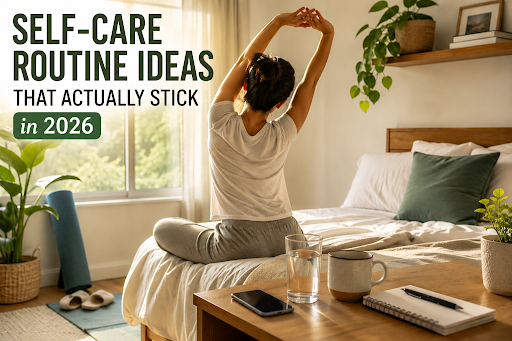
I used to work with a woman who had a whole shelf full of self-care stuff. Face masks. Bath bombs. A journal she bought three times because she kept losing the first two. Every few weeks she’d do a big “self-care Sunday,” candles and all, and by Wednesday she was just as burned out as before. She never had a real daily routine. Just big moments once in a while that looked nice but didn’t add up to much. That’s the problem with a lot of self-care routine ideas out there. People go big every once in a while instead of doing something small every day. And the small daily thing is usually what actually works. Not a very exciting answer, I know. Quick note first: I’m not a doctor or a therapist. Nothing here replaces real mental health care if you need it. This is just about everyday habits. What Actually Makes a Self-Care Routine Work Doing something small every day beats doing something big once in a while. Almost every time. A five-minute habit you keep up for a year does more for you than one three-hour spa day. Self-care in 2026 has shifted this way too: less about a big occasional reset, more about small stuff you barely notice you’re even doing. It also has to fit your real life, not some perfect version of it from an ad. A morning routine that takes an hour sounds great until you’re the parent working a 7am shift. Pick something you’d actually do on your worst week, not just your best one. Your worst week is the one that matters most. Morning Self-Care Routine Ideas Don’t check your phone the second you wake up. That’s the single biggest one and probably the hardest to actually follow, even five slow minutes before grabbing it changes how the rest of the morning feels. Get outside if you can, even just standing on the porch with coffee for a minute, sunlight early in the day helps regulate your body’s natural rhythm and it costs nothing. Stretch before anything else demands your attention, nothing fancy, just move a little before the day starts piling on. And drink a full glass of water before the coffee. Sounds too small to matter. Genuinely helps more than people expect it to. Evening Self-Care Routine Ideas Screens off an hour before bed if you can manage it. The blue light actually interferes with the melatonin your body needs to wind down, and this is one of the harder habits to keep since phones are, quite literally, designed to keep you scrolling past when you meant to stop. Do something calming instead, reading, a bath, journaling, whatever actually relaxes you and not just whatever’s trending on some self-care list this month. The specific activity matters less than doing something consistent your brain eventually learns to associate with winding down. And write down three things from the day, good or bad, doesn’t need to be profound or even coherent. Just gets stuff out of your head instead of spinning there while you’re lying awake trying not to think about it. Self-Care Ideas for Stress and Anxiety Deep breathing sounds too simple to actually do anything. It works anyway. Four seconds in, hold for four, four seconds out a few rounds of that and your nervous system actually calms down, not just your head telling you it should. Set small phone rules too. No notifications after a certain hour. No scrolling in bed. It doesn’t need to be extreme, just steady enough that your brain gets a real break each day. And talk to someone. This isn’t really a “hack,” but real connection helps with stress more than almost anything on this list.This is also something that gets skipped most by people who are swamped, and it’s crazy when you think about it. Need a daily list rather than a random assortment of thoughts spread out among a dozen tabs? Our self-care ideas tracker can help you do this in just five minutes. Self-Care on a Budget Self-care doesn’t need to cost anything, no matter what half the internet tries to sell you. Going outside is free. A hot shower with the lights dimmed is free. Sitting in silence for ten minutes with your phone in another room is free too and probably works better than most things for sale. If you do want to spend a little, small and steady beats one big splurge.A candle costing $10 that is lit weekly is more effective than a $150 spa session done once and forgotten. Common Mistakes People Make With Self-Care Think of it as an occasion rather than an indulgence on a daily basis. In fact, while it may be nice to treat yourself to a spa once in a while, it certainly will not provide you with the same muscle-building benefits that consistent indulgence provides. Following another person’s regimen verbatim rather than adapting it to your own life. While something might work for a wellness influencer who does not work odd hours, it does not mean that it will not work for you. Simply adapt it to make it work. Making it overly complex. Ten steps to take before bed sounds great in theory but can only last four days in practice. Start with something smaller and work up from there. Structured Routine vs. Spontaneous Self-Care It is perfect for those individuals who require some structure to get anything done. Spontaneous self-care where you do whatever comes across to you at that moment suits those individuals who feel burdened by a fixed schedule rather than being relaxed. None of the two is superior to the other, regardless of what is said on any wellness list. There are those individuals who work best with routines. For others, flexibility is key as even the routine will be guilt-inducing. Frequently Asked Questions What is the time needed for developing a self-care routine? The general estimate is from three weeks to eight
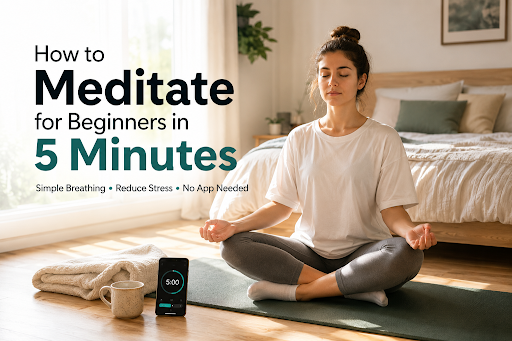
How to Meditate for Beginners in 5 Minutes
You’ve got five minutes before the kids wake up. Or before your shift starts. Or before that Zoom call you’re dreading. That’s the window, take it or leave it. So you type “how to meditate for beginners for 5 minutes” and get buried in apps, cushions, some guy on YouTube talking about “presence.” Skip it. Sit down. Set a timer for five minutes and just… don’t get up. That’s the whole trick. Nobody tells you breathing is easy it’s the sitting still that gets you. Why Five Minutes Is Plenty When You’re Starting Out Here’s what happens to most beginners. They pick a big goal, like twenty minutes a day. They sit down once. By minute six they’re bored and itchy. They never try again. I’ve done this myself. More than once. Five minutes doesn’t give you time to hate it. You can do it in your car before work. You can do it on the edge of your bed before your feet hit the floor.You can do this sitting on the edge of the bed, feet not even on the floor yet. You can do it in a bathroom stall if the day’s already falling apart by 9am. Nobody has to know you’re in there breathing instead of scrolling. There’s no minimum size for this to count. Five minutes on the edge of a mattress is the whole plan. How to Start Meditating in 5 Simple Steps Forget the teacher, forget the special room. Just find somewhere nobody’s going to knock on the door for five minutes.A chair, your bed, the floor, whatever you’ve got. Set a timer on your phone. That way you’re not peeking every thirty seconds to check the time. Sit up with your back fairly straight. Rest your hands on your legs. Close your eyes, or just look softly at the floor. Breathe like you normally do. No special trick yet. Just feel the air move in and out. Your mind’s going to wander. Fast. Probably to the grocery list, or something dumb someone said last Tuesday that you’re still chewing on for some reason. Doesn’t matter. Notice it, and drag your attention back to your breath. That’s it do that a hundred times if you have to. That’s the whole skill. Not clearing your mind. Just noticing it wandered and coming back. Again and again. If you already keep your workouts on a set schedule, treat this beginner meditation habit the same way. Same time. Same chair. Timer on. Done. That beats waiting to feel motivated. A Simple 5-Minute Breathing Exercise for Beginners Maybe “just breathe normally” feels too loose. Try this instead. Spend the first minute settling in. Take three slow breaths. Nothing fancy. For the next three minutes, breathe in for a count of four. Hold for four. Breathe out for six. The long exhale is what actually calms your body down, more than the counting itself. In the last minute, drop the counting. Breathe however feels natural. Sit for a bit before you open your eyes. Counting gives your brain a small job. Once the breathing thing feels normal, try a few others and see which one your brain actually takes to. Beginner Meditation Techniques Worth Trying Once the breathing version feels normal, try a few other beginner meditation techniques.Body scan is exactly what it sounds like. Start at your feet, move up slowly, head last. When you hit a tight spot, shoulders, jaw, wherever you’re clenched today just clock it. You’re not fixing anything. You’re just finding out where you’re holding tension without noticing. Counting breaths works well if you like having a number to hold. Count each breath out, up to ten, then start over. If you lose count at forty-seven, just laugh and reset. Nothing means you silently name a thought as it pulls you away. “Thinking.” “Planning.” “Worrying.” Then you go back to your breath. That’s really all it’s doing putting a little distance between you and whatever your brain’s up to. And if sitting still for five minutes sounds like torture, skip it. Walk instead. Walk slow. Feel your feet on the ground. None of these is the “right” one. Try each for a few days. Stick with whatever actually gets you to sit down again tomorrow. That’s the only metric that matters. Simple Meditation for Anxiety and Racing Thoughts Maybe your brain never shuts up. Twenty things going at once, none of them finished. Five minutes of quiet sounds like the last thing you’d want. That’s not you failing at this honestly it might mean you need it more than the person next to you who’s already calm. Loud brain day? Skip the breathing, try 5-4-3-2-1 instead. Name five things you can see. Just look around and count them off. Four you can touch. Three you can hear. Two you can smell. One you can taste. This pulls your mind out of the spiral and back into your body. That’s really what meditation is trying to do the whole time anyway. Your mind staying busy for the full five minutes is not failure. There was never a blank-mind goal. The National Center for Complementary and Integrative Health says meditation’s generally safe for healthy people. It’s also one of the more studied ways to deal with everyday stress. So that’s not nothing worth remembering on the days this feels more like a fight than a rest. The Best Time to Meditate When You’re New to It Mornings tend to work best. Your head isn’t yet jammed full of today’s garbage. Five minutes before you reach for your phone, and you have your calm baseline before the chaos begins. But truthfully, the ideal time is whatever window you’ll manage to carve out. Chaos reigning in your mornings? Give lunch a shot. Or five minutes once you’re in your parked car but not out on the road. I’d much prefer someone meditating at 6 p.m. every day over pursuing some “ideal” 6 a.m. time that they can
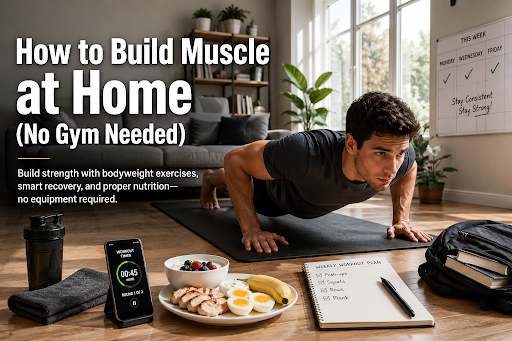
How to Build Muscle at Home
Dana had a gym membership. Then rent went up. The gym was a fifteen minute drive, and after a twelve hour shift, driving anywhere sounded awful. So she quit in March. By June she’d gained a few pounds and lost most of her strength. She figured that’s just what happens when you stop going to the gym. It’s not. I’ve watched people build real muscle in a living room with nothing but a rug and some patience. How to build muscle at home really just comes down to three things, and none of them are complicated. Push your muscles hard enough. Give them time to rest. Eat enough to grow. That’s really it. No gym card, no fancy machines, none of that. How to Build Muscle at Home Without Buying a Single Weight Here’s a thing most people don’t know: your body can’t tell the difference between a barbell and your own weight. It just feels how hard a muscle is working, that’s all. A pushup at the bottom of the move puts real strain on your chest and shoulders. So does a bench press, just with more weight behind it. A slow squat hits your legs the same way, no bar needed. The trick is making your bodyweight work harder. Slow down. A pushup that takes four seconds to lower is a totally different exercise than one you rush through in half a second. Try pausing at the hardest point too. Hold the bottom of a squat for three seconds before you stand up, and your legs will remind you about it the next morning. Honestly, that’s the whole secret behind how to build muscle without weights. Slow it down, hold the hard part longer, and your own bodyweight starts to feel like plates. A backpack full of books works too if you want extra load. Two water jugs make decent dumbbells in a pinch, and yes, I’ve actually used mine that way. A Beginner Home Workout Routine You Can Actually Stick To Most people quit their home routine by week two. Not because it’s too hard, it’s the opposite problem. They try to do too much, too fast, and burn out before their body catches up. I’ve seen this happen more times than I can count. So start small. Three days a week is plenty. Monday, Wednesday, Friday works for most people’s schedules. Skip the whole arm day, leg day thing beginners see online. Hit your whole body each time instead. Three short full-body workouts beat five scattered ones when you’re just starting out. A beginner home workout routine doesn’t need to be fancy. Try this: ten push-ups, ten squats, ten rows with a towel slung across a door frame, and a thirty-second plank. Take a break for one minute and repeat twice more. Can be completed in less than thirty minutes. Once ten reps feels easy, don’t tack on a fourth round right away. Add a few more reps instead. Or slow the movement down even more. Small steps still count as progress. Bodyweight Exercises to Build Muscle That Actually Work Not every move on YouTube earns a spot in a beginner routine. This list will get you covered with the least amount of confusion. The first exercise is the pushup. It works on your chest, shoulders, and the back side of your arms. And it can be increased or decreased in difficulty by moving your feet closer together, or doing it while on your knees, and putting your hands either on a chair or a couch. The second exercise is the squat, which works on all of your muscles below your waist. Feet shoulder-width apart, and as you go down, try to imagine you’re sitting on a stool. Rowing is an exercise that is usually ignored due to the lack of a pull-up bar. This can be solved by placing a towel on a sturdy door handle and grabbing it from both ends while pulling your chest towards the door. Plank.Hold one for thirty seconds. Rest. Do it two more times. Add a few seconds each week. Those four bodyweight exercises to build muscle cover your whole body. No dumbbell required. How Often You Should Train (And Why Rest Actually Matters) Muscle doesn’t grow during your workout. It grows after, while you sleep and eat, when the small tears from training patch themselves back up a little stronger than before. And so, when you train your muscles daily, you are in essence doing something detrimental to yourself. Let your muscles have an entire day’s rest before another session. Seven half-baked sessions are less effective than three well-rested sessions. This is where sleep becomes critical. Seven or eight hours gives your body room to repair. Cut that short and you can nail every workout and every meal and still barely see anything change. What to Eat So the Work Doesn’t Go to Waste You can do every pushup right and still not grow if you’re not eating enough protein. Protein is the raw material your body uses to fix the muscle you just wore down. These foods include eggs, chicken, beans, Greek yoghurt, and cottage cheese, all inexpensive foods and do not require culinary skills. As observed by the National Institutes of Health, protein directly helps muscles repair and build themselves after exercising. Calories matter too, not just protein. You can’t build muscle out of thin air. A lot of beginners train hard, eat too little, and then wonder why nothing in the mirror is changing. This is the part people forget when they think about how to build muscle at home — the food matters just as much as the workout does. Mistakes That Stop Beginners Before They See Results The biggest one, and I get it, progress feels slow at first. Muscle takes six to eight weeks of steady training before you can actually see a difference. Jump to a new plan every few days and you keep resetting that clock, back to square