
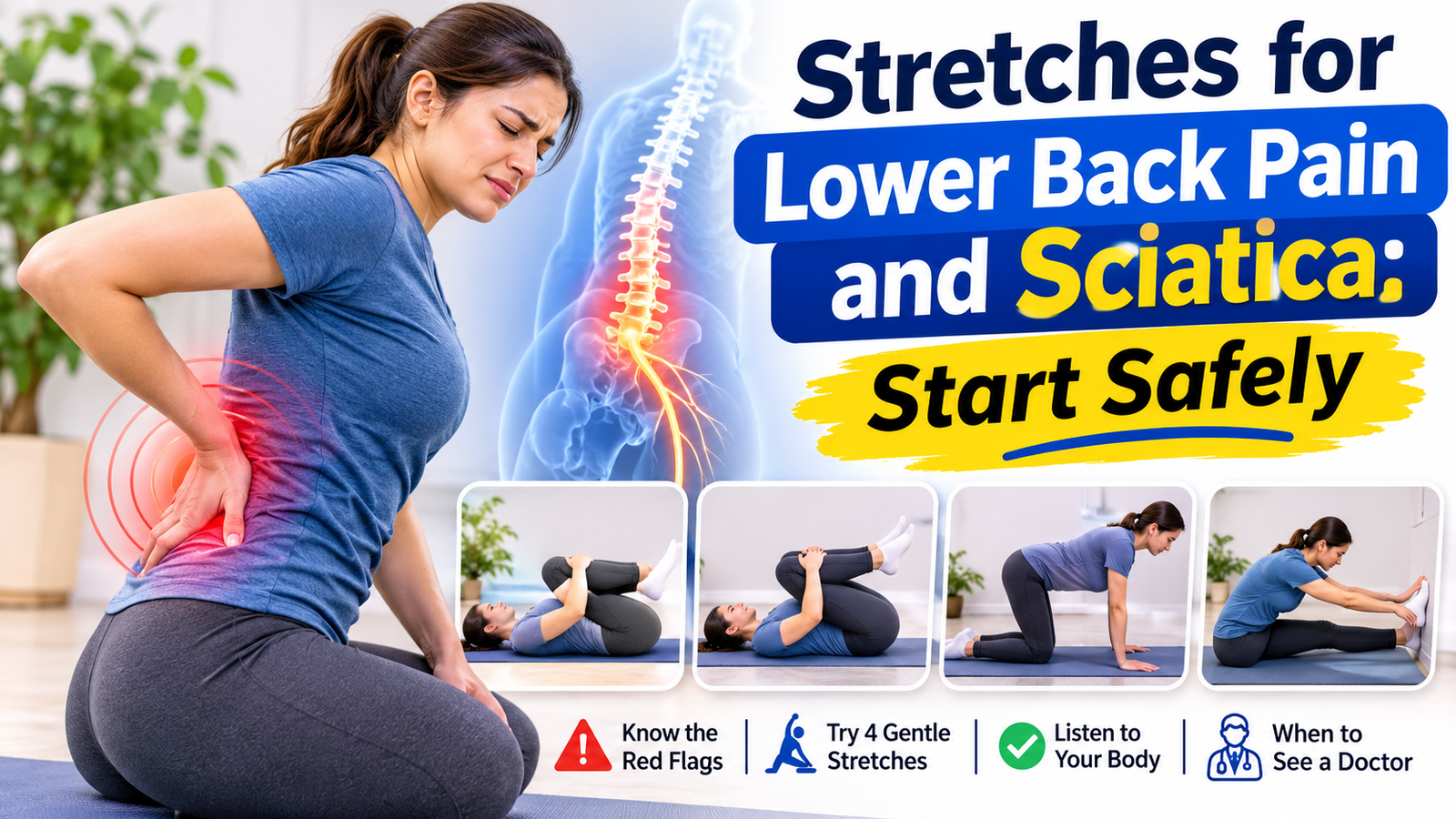
It starts with a twinge when you stand up from the couch. Then a dull ache settles into your lower back. A few days later, something odd shows up down one leg, maybe a burn, a tingle, or an electric zip when you sneeze. Now you’re reading about stretches at midnight, hoping one of them will switch it off. With this kind of pain, the order matters. Warning signs come first; stretches come second. This guide on stretches for lower back pain and sciatica gives you both, in that order. I’m not a doctor or a physical therapist, and this is general information, not medical advice. Facts from health sources are marked. The rest is my own view. First, the warning signs Sciatica is merely a symptom, not a diagnosis. According to MedlinePlus, accessed on August 27, 2024, sciatica means “pain, weakness, numbness, or tingling in the leg.” This condition happens because of damage to or compression of the sciatic nerve. The causes of sciatica include, among others, such medical conditions as a herniated disk, spinal stenosis, and piriformis syndrome. You can check all symptoms of sciatica on the MedlinePlus webpage. According to the same page, you should contact your health care provider immediately in case of experiencing loss of control of urine or stool; weakness or numbness of the buttock, thigh, leg, or pelvis; fever without an evident cause with back pain; back pain after a serious blow or fall; and pain that cannot be alleviated. Also, one needs to contact his/her provider when the bout of back pain continues for more than four weeks, or when it differs from previous bouts and is worse. As MedlinePlus does not use terms such as “emergency room,” I will consider it safe to treat sudden loss of bladder or bowel control and rapidly developing leg weakness as emergencies.If any of that sounds like you, a professional is your next step. Stretching can wait. What the sources say about stretches for lower back pain and sciatica The MedlinePlus web page talks about early exercises, core strengthening, and spinal flexibility training, but it does not talk about stretches. According to the web page, a physical therapist may suggest an appropriate training program. The Patient Advice Leaflet provided by the South Tees NHS, November 2024, says, “There is no one best exercise for people with sciatica, so select the things that you find enjoyable.” It says that gradual and progressive exercises are safe and effective and mentions walking and swimming as examples. No one can guarantee that a certain stretch will solve your problem. However, I can tell you about the safe ones recommended by the health care system and about paying attention to your body’s signals while stretching. Don’t stay in bed. MedlinePlus says bed rest isn’t recommended. It suggests reducing activity for the first couple of days, then slowly returning to usual activities. Geisinger’s guide on easing sciatica at home, published in December 2022, agrees, saying “too much bed rest can make things worse.” It suggests walking if you feel up to it. South Tees says pain is usually worst in the first few weeks and eases most over the first few months, and that at twelve weeks about half of people with sciatica have significantly improved. For some people, recovery takes longer. Four gentle stretches to try These stretches for lower back pain and sciatica come from the Geisinger page, described in my own words. Move slowly. None of them should be pushed through pain. Lying knee-to-chest.Knee to chest. Lie down with your legs extended straight. Lift one leg and bring your knee to your chest while pulling behind your knee and stretching. Hold on to it for a few seconds and repeat with other leg. Both knees to chest. Lie down on your back and lift both legs. As per Geisinger, you can move your head towards your knees if you want to increase the flexibility, but it’s better not to do so if your neck is not flexible enough. Hold the position briefly and repeat. Kneeling hip stretch. Kneel on all fours. Take one leg and move it towards opposite hand side. Geisinger gives no hold time for this one, so keep it brief. Seated hamstring stretch. Sit on the floor with one leg straight out and your foot against a wall. Lean forward over that leg until you feel a pull in your lower back muscles, then switch legs. Our guide on hamstring stretches for lower back pain covers this area in more detail. The page gives hold times only for a few seconds on some of these, so I won’t invent longer ones. A few slow breaths for each is a sensible place to start. That’s my suggestion, not an official rule. How to tell a good pull from a bad sign Here’s the part most lists of stretches for lower back pain and sciatica skip. You want a mild pull in the muscle, the kind that eases when you relax. That’s the good kind. The bad kind is pain that shoots down your leg, new numbness or tingling, or pain that gets worse as you hold. If that happens, ease off right away, and don’t repeat that stretch. This is my own general safety advice, not from the sources above. If a stretch keeps bringing back leg symptoms, bring it up with a doctor or physical therapist. What about heat, ice, and pain relievers? MedlinePlus recommends ice for 48 to 72 hours followed by heat. Geisinger recommends ice packs followed by heat packs for 20 minutes each. Both sites recommend over-the-counter pain relievers such as ibuprofen and acetaminophen. I am not giving any medication advice; you should talk to your doctor or pharmacist. Move a little every day. Stretching is only one piece. South Tees says the aim is to do “a tolerable level of activity a number of times per week.” Short walks count, and South Tees says keeping up work and social plans