
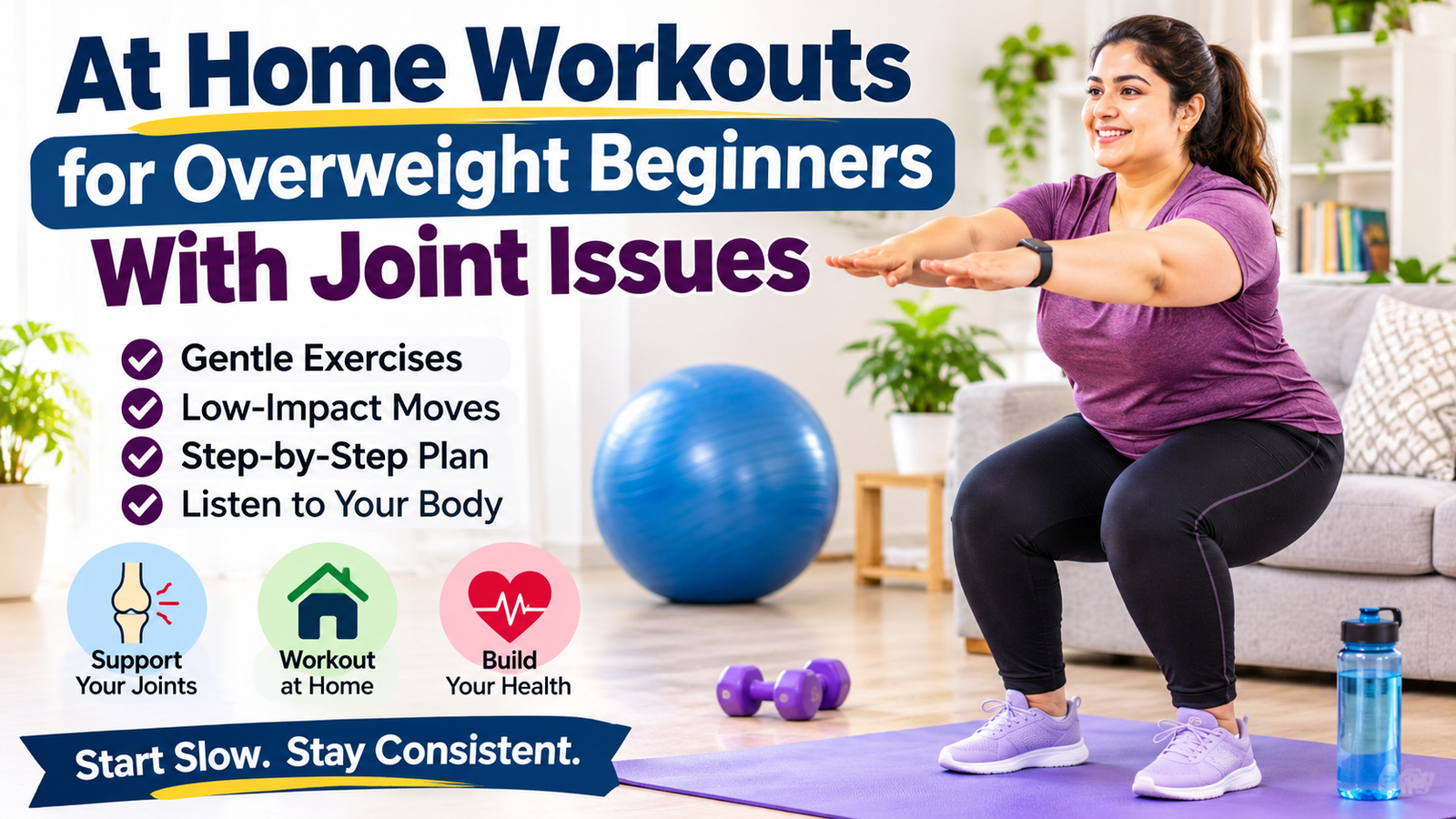
It’s already difficult to start working out. It’s even more difficult when your knees hurt, your hips are screaming, and all of the videos look like they’re designed for somebody else. Maybe you have already tried one workout and after being sore for three days you stopped. But that doesn’t mean you failed. You’ve just chosen a program that wasn’t suitable for you. This guide is meant for overweight beginners with joint issues who want to work out at home. This guide will show you gentle exercises, how to create a workout program and how to listen to your body. Start with a quick check-in. you can speak with a healthcare provider. According to the CDC website regarding physical activity and arthritis, published in February 2025, one should consult a health care provider when possible before engaging in such activity. The site also states that people with arthritis “may benefit from seeing a physical therapist when beginning physical activity.” Moreover, another CDC website mentions that if you have a chronic disease, “be sure to talk with your doctor about the types and amounts of physical activity that are right for you.” Inquire about what types of movements to avoid and the level of intensity you should go to as well as about what types of pain you should be wary of. If you experience chest pain, dizziness, and sudden swelling of the joints while exercising, immediately stop. What “gentle” means for at-home workouts for overweight beginners with joint issues On the page on the CDC website, activities are listed which put “no or low stress on the joints” including brisk walking, cycling, swimming, and tai chi. It also mentions that you need to pick weights and resistance bands which don’t cause joint pain.” It’s “pick moves that don’t stress the joint.” Another CDC page, “Adding Physical Activity as an Adult,” from December 2025, says to “pick physical activities that you enjoy and that match your abilities.” And it says, “Some physical activity is better than none.” “If you only manage five minutes today, that counts. Moves for at-home workouts for overweight beginners with joint issues These exercises are based on general fitness information and not on one single source; therefore, consider them as a menu of options and consult an expert who would be appropriate for you. Start slow and exercise within your limits. To exercise your legs, sit down and stand up with the help of a strong chair and use your hands to assist you, but only go as low as you can. Stand up next to a counter and use your hands for support, and march in place while keeping your knees slightly raised. Lying on your back with knees bent, lift your hips a little, and this will exercise the back part of your legs and your hips. To exercise your upper body, you may start with wall push-ups. Stand up against a wall, put your hands on the wall, and bend your elbows to get close to the wall and then push yourself away. You may also consider doing arm exercises by raising them when seated while holding some light weight like a soup can. Try to walk in your house or garden, march while sitting, or take side steps. Bicycle or swimming can be helpful for joint issues. In case flexibility is an issue, then warm up and take slow stretches. If your issue is muscle tightness, you can check out , our guide on hamstring stretches for lower back pain explains two careful ones. How many at-home workouts for overweight beginners with joint issues should you do? According to the CDC, an adult requires 150 minutes of moderate exercise per week and two days of muscle training. However, this can be done in installments, and “even just 5 or 10 minutes at a time is good for you.” If 150 minutes of exercise sounds unattainable currently, treat it as an abstract future goal. The actual goal for this week is to simply attend. This is what I would like to try, not medical advice: In week one, spend five to ten minutes, on a few days, with rest days in between. Then, after week one, increase a little bit more, either time or days, but not both simultaneously. Reading pain the right way Beginners often get stuck here. According to the CDC, “When you begin or increase an exercise routine, do so gradually and listen to what your body is telling you.” Further, the CDC mentions that it is usual for individuals to experience aches, stiffness, or swelling once they begin any physical activity. With time, arthritis pain that develops as a result of physical activity will improve. The CDC recommends that one should contact their health care provider in such a case or if the symptoms are too painful. Hence, it is expected to feel a bit of ache the following day. Sharp pain during a movement, constant pain, and swelling are totally different cases. This is my interpretation of the language used in the statement. Make it easier to stick with An exercise routine for the overweight person with joint problems will succeed only if he or she can easily start it. Make your workout space as simple as possible. You will only need a sturdy chair, a flat spot on the floor, a wall, and a bottle of water. Plan your workout at the same time of the day, say after breakfast. Make sure you have rest days as part of your workout schedule. Look for progress in areas other than weight loss, for example finding it becoming easier to climb the stairs. Be kind to yourself. The vast majority of fitness materials are created for those who are feeling great. Avoid the cliché “No Pain, No Gain.” Your task is to earn the trust of your body step by step.Some days you’ll do less. That still counts. Common mistakes The most common mistake made by overweight beginners with