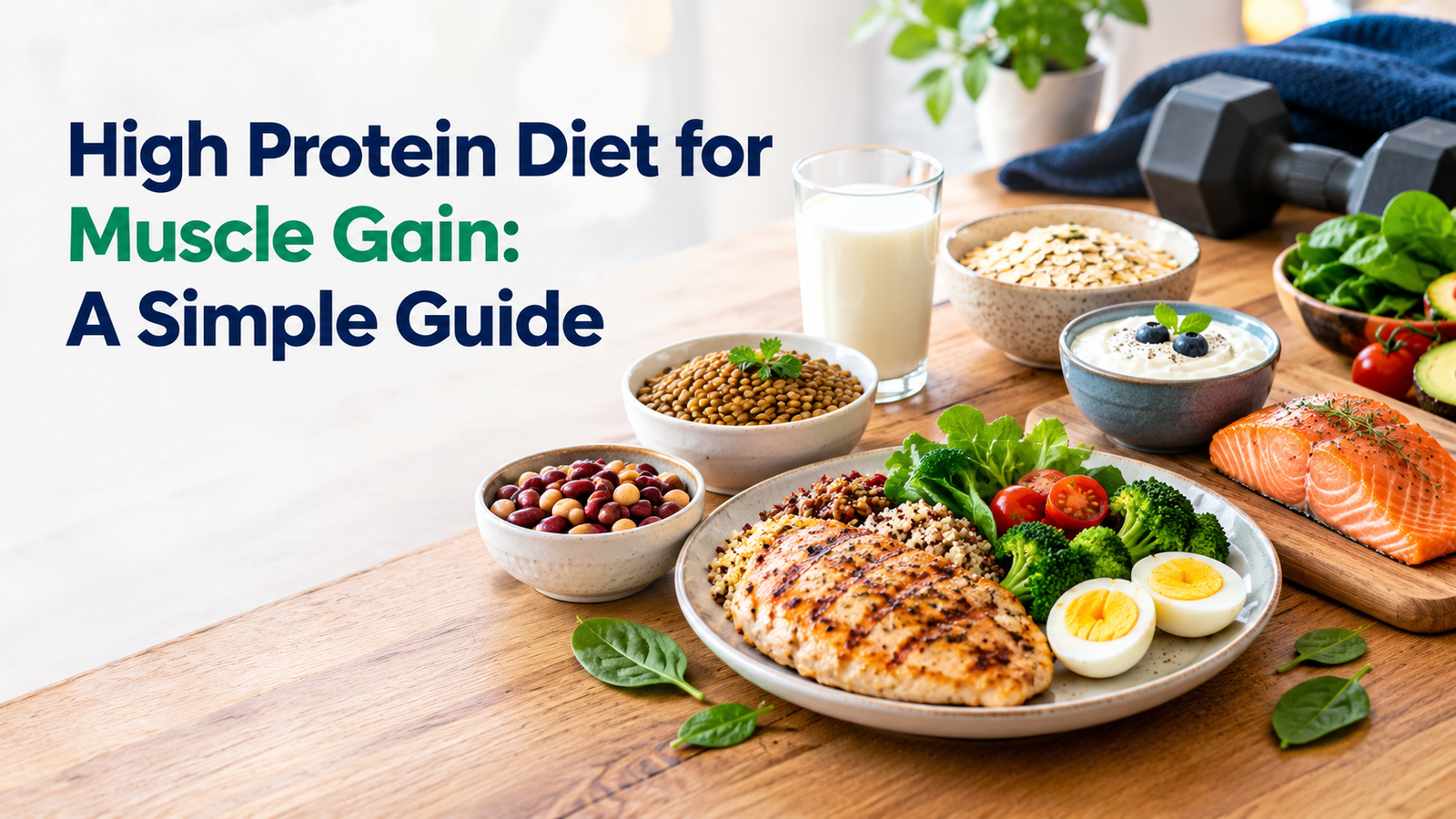
You’ve been lifting for six weeks. You show up, you sweat, and you add a little weight. Later on a friend makes the comment, “You’re not getting enough protein.” Now you are scrutinizing the grocery store aisle full of containers, bars, and brand promises. You can relax, a high protein diet for muscle building doesn’t require you to fill your cart with powders, it needs precisely defined objective and simple food on the table. This guide keeps it simple. I’ll show you what the NIH and MedlinePlus say, give you the math, and walk you through a sample day. Facts from official sources are marked. Anything else is my opinion. This is general information, not medical advice. What does protein do for muscle? The body has the ability to build proteins with the help of amino acids, which are its building materials. Proteins are used by the body for cell repair and regeneration, and the National Library of Medicine’s Medline Plus service refers to proteins as the building blocks of life. According to a fact sheet published by the Office of Dietary Supplements of the National Institutes of Health (NIH) on dietary supplements related to exercise and athletic performance, protein plays an important role in muscle building. However, it cannot be overstated that protein does not replace the need for training, as protein helps muscles work efficiently when doing exercises. You need to note this last point: protein cannot replace the exercises performed by the muscles. While drinking a protein shake, you cannot build muscles just by remaining seated without performing any additional exercises. The rules of a protein diet aimed at muscle growth work wonders only when combined with the physical exercises that one must do during training. If you need a place to start, see our guide on how to build muscle at home. How much protein fits a high protein diet for muscle gain? Here’s where people get lost. So let’s use real numbers.According to the NIH fact sheet, athletes should take proteins from 0.55 to 0.9 grams per pound of body weight, which means 1.2 to 2.0 grams per kilogram. The same page says it reports no safety concerns at daily intakes for athletes of up to about 2.0 grams per kilogram. It gives an example. That’s 136 grams for a person who weighs 150 pounds. Now let us do some calculations using the same weight. For an athlete at 0.55 grams per pound, it will be 83 grams a day, while at 0.9 grams, it will be 135 grams. This is the NIH range translated into numbers. (Math is mine. Range is NIH’s). The MedlinePlus gives another broader guideline for the amount of protein intake. They state that for healthy individuals, the recommended intake of protein is 10% to 35% of the daily calorie consumption. In case of a 2,000 calorie diet, 100 grams of protein is approximately 20% of the total calories. What does the term “high” mean in this context? I would say it means trying to stick to the NIH range for athletes rather than just the lowest limit of the overall range. Still, your target depends on many factors, and only a physician or dietitian can determine it. Easy foods for a high-protein diet for muscle gain You do not require any elaborate dishes. MedlinePlus refers to some common things. Animal products: meat, fish, poultry, eggs, and milk. Plant products:soy, tofu, tempeh, beans, lentils, split peas, nuts, seeds, and certain grains such as quinoa. According to MedlinePlus, whole grains are richer in protein than grains that have been processed. It says there is a simple rule. The protein-rich foods have around 7 grams of protein per ounce. Examples include an ounce of meat, fish, or poultry, one egg, 1/4 cup of tofu, and 1/2 cup of cooked beans/lentils. One word of caution from MedlinePlus. Nuts are high in fat, so watch the portion size. And eating more calories than you need can lead to weight gain. A sample day on a high protein diet for muscle gain This is a made-up example to show how the numbers add up. Yours will differ. I’m using MedlinePlus’s rule of about 7 grams per serving. That’s about 98 grams. For our 150-pound example, it lands inside the 83 to 135 gram range. And there’s no powder in sight. Round numbers like these are only estimates. Real foods vary. Do you need powder for a high protein diet for muscle gain? Short answer: not always. It’s a convenience, not a must. The NIH fact sheet explains that eating animal foods with complete proteins, or plant foods that combine to give all the essential amino acids, supplies what you need. It adds that protein powders made from complete proteins, especially whey, can do the same. It doesn’t say athletes must take them. My view is simple. If food gets you to your target, you don’t need a tub. If your schedule is wild, a powder can fill a gap. Check labels, and ask a professional before you start any supplement. Does timing matter? Arguments about this topic are popular among people. According to the National Institute of Health, there’s no scientific proof that consuming proteins and BCAAs together to build muscle. Note: BCAA is one of the components of protein, and is therefore referred to as branched-chain amino acids. Thus, it is not important to worry about the exact time that you eat it. Spread your protein through the day and hit your total. That’s my practical take, not a rule from the page. What else matters for gaining muscle? Food is only part of it. Training. Lift or engage in resistance training on a regular schedule. The muscles have to have a reason to get bigger. Calories. Making muscles requires energy. Many people require enough calories in general rather than just protein. I can’t give you the number of calories, as it depends on you as an individual. Sleep. The muscles recover while sleeping.