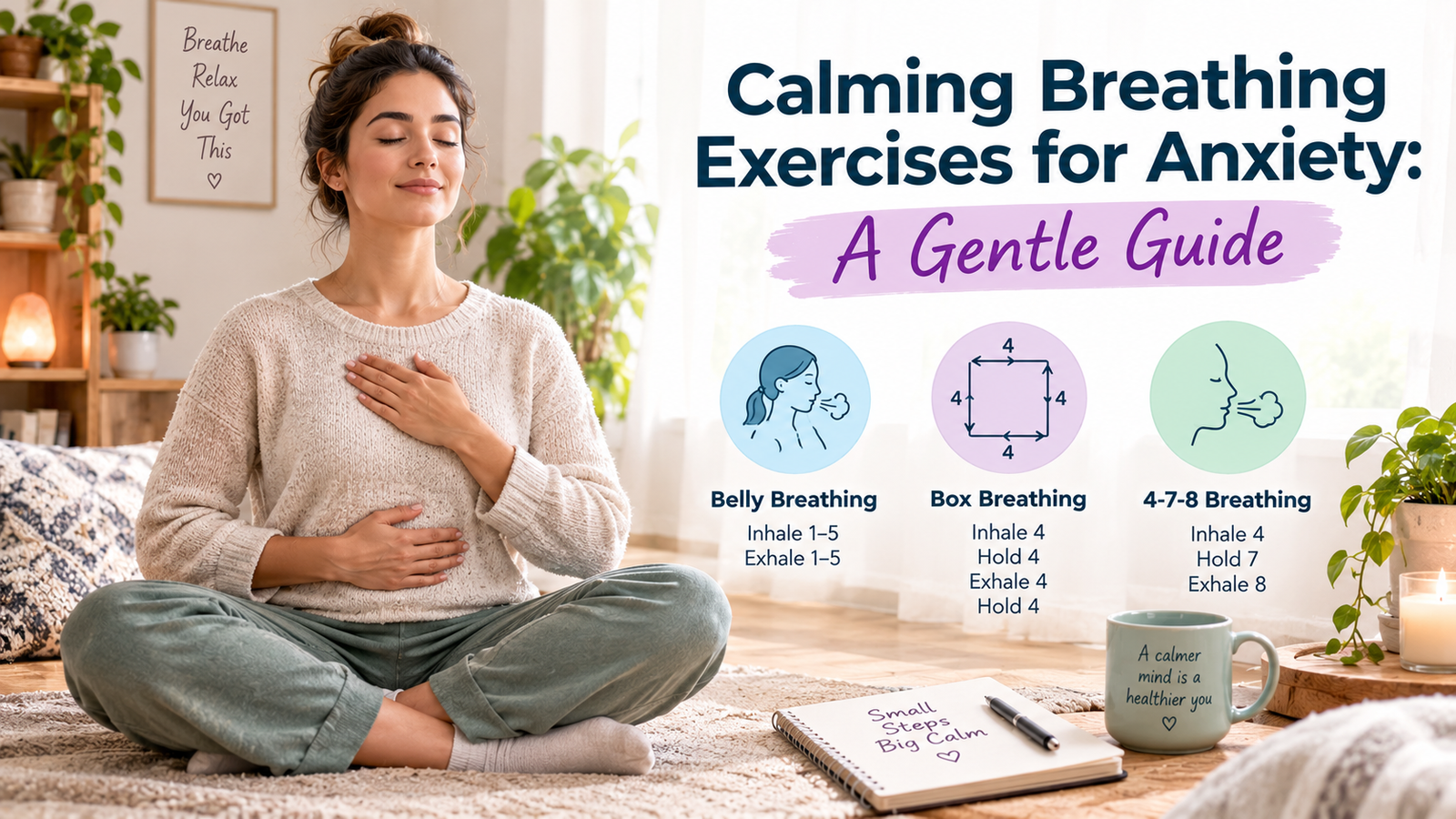
2 a.m. Ceiling. A conversation you keep rehearsing that may never happen. Your jaw is clenched, your chest feels tight, and your breath has crept up into your shoulders. You didn’t decide that. It just happened. Anxiety isn’t only a thought problem. It’s physical, and breathing is one of the few physical things you can steer on purpose. Calming breathing exercises for anxiety won’t fix a rough week. But they can take the edge off, even on a night when your head won’t shut up.I’m keeping this tight: three exercises, where to do them, and a plan you can actually keep. Why calming breathing exercises for anxiety make sense Breath influences stress, and stress influences your breathing. They feed off each other. Therefore, when reasoning with yourself doesn’t work, then you may try a different angle – that of breathing. Slow exhalation is one of the easiest methods of letting your body know that everything is all right. This is no magic trick. Breathing cannot make your anxiety disappear. However, it decreases tension in the moment. In time, you might realize sooner when your body starts getting tensed, which is already something useful. Three calming breathing exercises for anxiety to learn To begin with, you need to try out belly breathing. It is the basis for the next two techniques. Place your hand on your belly and inhale air via your nose while your hand rises and your chest remains still. Then exhale slowly through your mouth, as if you want to fog up the glass. According to NHS, it might be beneficial for some people to count from 1 to 5 and to continue for at least five minutes.Two minutes is a fair start. Can’t get to five yet? The NHS says that happens at first. Don’t expect fireworks either. A looser jaw, shoulders down an inch, a yawn. Those count. If you feel more tense, breathe smaller and back off. At night, I’d go with the 4-7-8 breathing technique. In through the nose for four. Hold for seven. Out through the mouth for eight, like cooling soup. The long exhale is the part doing the work. Four rounds is plenty. Feeling lightheaded? Some people do at first. Shorten the counts or skip the hold. Box breathing as a means of relieving anxiety is the one that sticks in your mind. In four, hold four, out four, hold four. Just a few rounds should be fine. If holding is what drives you crazy, then leave it out. In four out of four, everything will be okay. You don’t have to do all three. Choose the one that seems the least goofy and practice it for a week. Set up your space for calming breathing exercises for anxiety The NHS states that one can perform breathing exercise while either standing or sitting comfortably on a chair, lying on a bed or mat. The NHS recommends relaxed and cozy clothing. If one is taking the standing position, he should ensure that both feet are apart at shoulder’s width. In addition to this, it is necessary to put the phone, or even better, move it to another room. Build a routine that sticks. Berkshire Healthcare NHS Foundation Trust notes that doing breathing exercises regularly helps to relieve some of the physical impact of stress and anxiety. They also suggest that breathing exercises should be linked to something you need to do regularly, like brushing your teeth. Make the plan almost laughably small. Two minutes of belly breathing before you grab your phone in the morning. One round of box breathing around lunch, even if you’re sitting in a parked car. Four rounds of 4-7-8 in bed. Five minutes in total, less than it takes most of us to pick something to watch. Which one is it? Belly breathing works anywhere. 4-7-8 is for bed. Box breathing suits a tense afternoon at your desk. That’s my take, not a rule, so swap whenever one stops working. Try keeping score for two weeks, too. Rate your level of stress on a scale from 1 to 10 before and after. An estimate is fine, and it will show you what really works. These simple actions make deep breathing for anxiety effective under pressure, since your body is familiar with the technique. Want something longer and quieter? Try our 5-minute meditation guide for beginners. If you need relief right now, our fast breathing exercises for anxiety post are the better start. Racing thoughts and other snags Thoughts will crash the party while you practice calming breathing exercises for anxiety. That’s normal. Let them drift by and go back to the next breath. Some people count only the exhale. Others whisper “out” as the air departs. Both provide your brain with a small task to perform so it won’t search for something larger. The biggest mistake is overexertion, like inflating a balloon. Try to breathe gently. Another is giving up at the first attempt. It will seem strange and maybe even amusing in the first few rounds. Plus, don’t wait until you’re stressed to practice deep breathing exercises; do it regularly before that happens. When breathing isn’t enough It is essential to keep in mind that breathing is merely a technique that cannot solve the problem. In case you notice that anxiety is affecting your sleep, work, study, and relationships, seek medical help from professionals. Many people find it helpful to use breathing techniques alongside other treatment means. If you have pain in your chest and have difficulty breathing, get medical assistance urgently. FAQ What are the best calming breathing exercises for anxiety? A good way to begin practicing is to start with your abdomen. It takes only a few weeks to master this so you can then work on 4-7-8 breathing exercise and also box breathing for a busy mind. It doesn’t really matter which of the two techniques you choose; what is important is that you are consistent with it. How much time do