
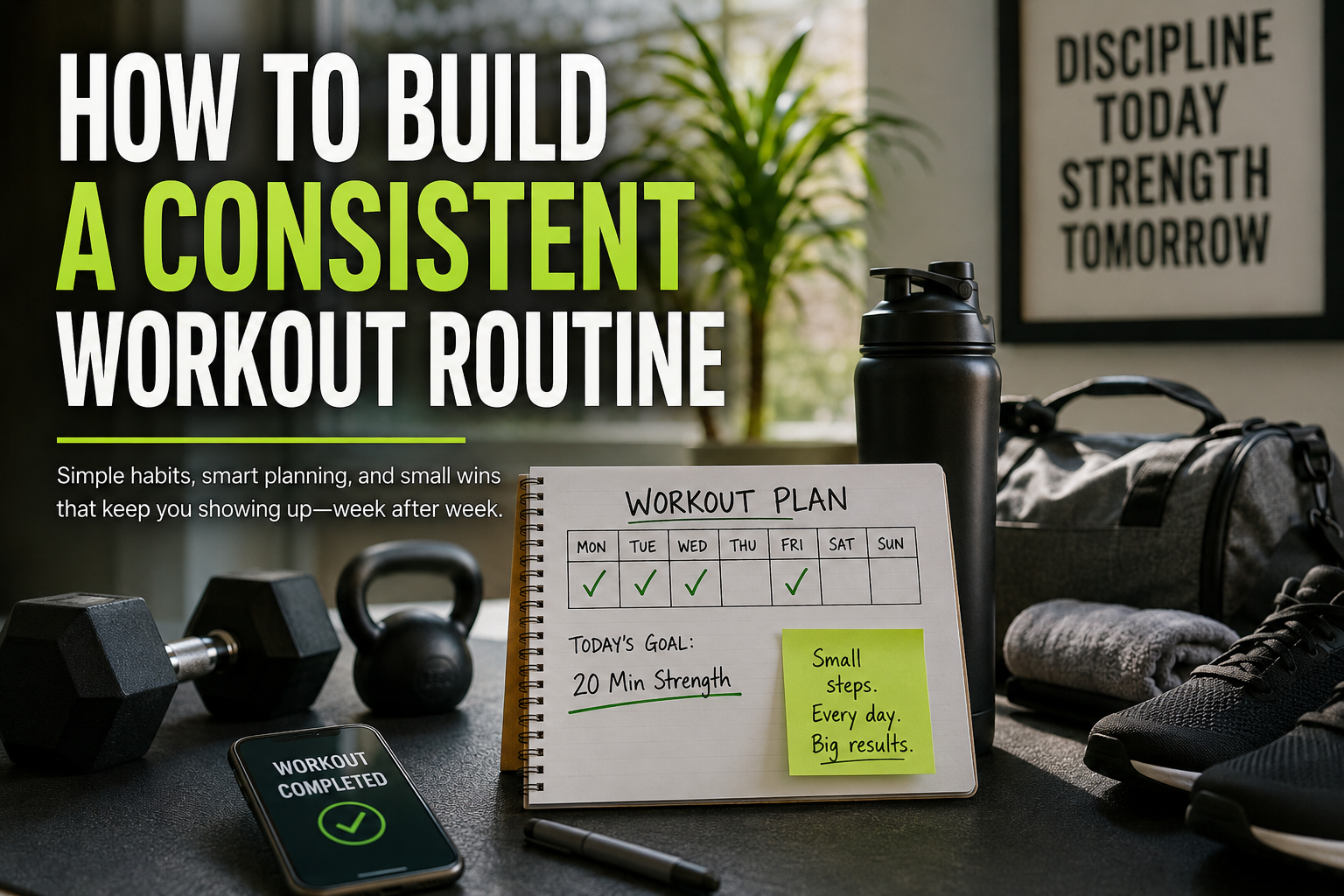
Four Januarys in a row, same story. New gym membership, meal prep containers stacked in the fridge like I actually meant it this time. Week three, I’d miss two sessions, feel weirdly guilty, and just… stop going. Not “take a break.” Stop. I’m guessing that’s more common than fitness content usually lets on. More motivation was never the problem. I had tons of it every January 1st. How to build a consistent workout routine turned out to be a much less exciting question than I wanted it to be, and the answer is basically: build something small enough that it survives the weeks you don’t feel like it. This is true for most weeks, if we’re being honest. Start Smaller Than Your Ego Wants Five days, then work becomes demanding, or your child falls ill, or you simply feel fatigued, and the entire plan is abandoned by the fourth week. our fourth week. bandoweek. y the fourth week. abandoned by the fourth week. simply feel fatigued, and the entire plan is abandoned by the fourth week. Three shorter sessions you actually finish will always beat five ambitious ones you quietly abandon. So start stupidly small. Twenty minutes, three days a week, for the whole first month. It should feel almost too easy. That’s the design, not a flaw in it. Calendar It Like You Can’t Cancel Vague plans lose to real appointments every time, and workouts are no exception. “Sometime this week” never happens. Tuesday at 7am does, mostly because there’s nothing left to decide once it’s already on the calendar. You wouldn’t cancel a dental appointment simply because you were tired when the appointment occurred that morning. Approach the training slot in the same manner as the appointment you won’t cancel simply because you’re tired that day. Attach It to Something Automatic Here’s the trick with habit stacking: your brain doesn’t need to remember a brand new behavior if it’s bolted onto one that already runs without thinking. Pour the coffee, then change into workout clothes immediately. Walk in the door after work, then go straight into the session before you sit down, because we both know what happens once you’re on that couch. The existing habit does the remembering for you. Works better than any phone reminder I’ve ever set, and I’ve set a lot of them. Pick Something You Won’t Dread on the Drive Over If it makes you feel like you’re being punished, then it’s time to stop running. It can be anything from swimming to weight training or even just playing on your local team, but what matters is finding something you won’t dread when you look at the clock. The workout you’ll still be doing in month three beats the one that burns more calories but dies in week two. Group classes and workout partners help here in a way that’s a little embarrassing to admit. Humans are oddly bad at flaking on people they’ve made plans with, even the same people who have zero problem flaking on themselves. Use that. It works. Track It With Something Dumb and Simple Not a spreadsheet with color-coded tabs. A checkmark on a wall calendar for every workout you finish. Four checkmarks in a row start pulling you toward a fifth in a way that feels almost physical, which sounds silly until you’ve actually watched it happen to yourself. FitForce Lab has beginner routines built for exactly this kind of slow, checkmark-driven progress instead of the all-or-nothing programs that torch most people’s momentum by February. Add More Only Once It Gets Boring Once your baseline stops feeling hard, that’s the cue to add something, not before. An extra five minutes, a heavier weight, a fourth day. People tend to blow this in one of two directions: never adding anything and stalling out for months, or piling on way too much too fast and landing right back in the same burnout they were trying to escape.Slow and boring wins here. It is true that your body adjusts according to what load you place on it, and hence not making any changes will mean that no results are forthcoming either. Build Flexibility Into Your Workout Routine A lot of routines collapse because the underlying plan only survives a perfect week. Zero missed sessions, zero bad sleep, zero stress at work. That’s not really a plan. It’s a bet against normal life, and normal life wins basically every single time. Build slack in from the start. Going for three times per week is the objective, and even two in a week is not failure; it is a lighter week. All-or-nothing attitude can bring you right back into stopping after a tough week very quickly, so define success beforehand when you will be caught in such a week. It will interfere with your plan no matter how good your plan is. Figure out before what your worst version of that is: ten instead of thirty, walking instead of training. On the genuinely bad weeks, the goal stops being progress. It’s just keeping the chain from snapping completely. The CDC’s physical activity guidelines back this up too, noting that shorter bouts of activity spread across the week still add up to real benefit, so that shrunken version on a rough day isn’t a throwaway effort. It counts. Get Back on Track After Missing a Workout Nobody keeps an unbroken streak going for years, not really. Illness, travel, and plain burnout happen to everyone, including the people who look impressively consistent from the outside. UCLA Health frames sustaining a routine as mostly a matter of habit formation, which means interrupted habits are recoverable ones, not dead ones. A missed week doesn’t erase what you already built. It just means picking the calendar block back up where you left it instead of starting from zero, which is the part I got wrong for four Januarys straight. I still miss stretches now, usually around the holidays or during a brutal work month. The only