
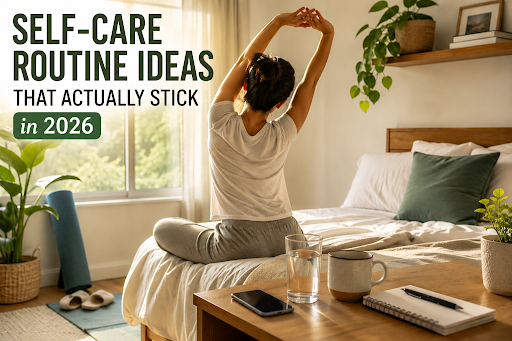
I used to work with a woman who had a whole shelf full of self-care stuff. Face masks. Bath bombs. A journal she bought three times because she kept losing the first two. Every few weeks she’d do a big “self-care Sunday,” candles and all, and by Wednesday she was just as burned out as before. She never had a real daily routine. Just big moments once in a while that looked nice but didn’t add up to much. That’s the problem with a lot of self-care routine ideas out there. People go big every once in a while instead of doing something small every day. And the small daily thing is usually what actually works. Not a very exciting answer, I know. Quick note first: I’m not a doctor or a therapist. Nothing here replaces real mental health care if you need it. This is just about everyday habits. What Actually Makes a Self-Care Routine Work Doing something small every day beats doing something big once in a while. Almost every time. A five-minute habit you keep up for a year does more for you than one three-hour spa day. Self-care in 2026 has shifted this way too: less about a big occasional reset, more about small stuff you barely notice you’re even doing. It also has to fit your real life, not some perfect version of it from an ad. A morning routine that takes an hour sounds great until you’re the parent working a 7am shift. Pick something you’d actually do on your worst week, not just your best one. Your worst week is the one that matters most. Morning Self-Care Routine Ideas Don’t check your phone the second you wake up. That’s the single biggest one and probably the hardest to actually follow, even five slow minutes before grabbing it changes how the rest of the morning feels. Get outside if you can, even just standing on the porch with coffee for a minute, sunlight early in the day helps regulate your body’s natural rhythm and it costs nothing. Stretch before anything else demands your attention, nothing fancy, just move a little before the day starts piling on. And drink a full glass of water before the coffee. Sounds too small to matter. Genuinely helps more than people expect it to. Evening Self-Care Routine Ideas Screens off an hour before bed if you can manage it. The blue light actually interferes with the melatonin your body needs to wind down, and this is one of the harder habits to keep since phones are, quite literally, designed to keep you scrolling past when you meant to stop. Do something calming instead, reading, a bath, journaling, whatever actually relaxes you and not just whatever’s trending on some self-care list this month. The specific activity matters less than doing something consistent your brain eventually learns to associate with winding down. And write down three things from the day, good or bad, doesn’t need to be profound or even coherent. Just gets stuff out of your head instead of spinning there while you’re lying awake trying not to think about it. Self-Care Ideas for Stress and Anxiety Deep breathing sounds too simple to actually do anything. It works anyway. Four seconds in, hold for four, four seconds out a few rounds of that and your nervous system actually calms down, not just your head telling you it should. Set small phone rules too. No notifications after a certain hour. No scrolling in bed. It doesn’t need to be extreme, just steady enough that your brain gets a real break each day. And talk to someone. This isn’t really a “hack,” but real connection helps with stress more than almost anything on this list.This is also something that gets skipped most by people who are swamped, and it’s crazy when you think about it. Need a daily list rather than a random assortment of thoughts spread out among a dozen tabs? Our self-care ideas tracker can help you do this in just five minutes. Self-Care on a Budget Self-care doesn’t need to cost anything, no matter what half the internet tries to sell you. Going outside is free. A hot shower with the lights dimmed is free. Sitting in silence for ten minutes with your phone in another room is free too and probably works better than most things for sale. If you do want to spend a little, small and steady beats one big splurge.A candle costing $10 that is lit weekly is more effective than a $150 spa session done once and forgotten. Common Mistakes People Make With Self-Care Think of it as an occasion rather than an indulgence on a daily basis. In fact, while it may be nice to treat yourself to a spa once in a while, it certainly will not provide you with the same muscle-building benefits that consistent indulgence provides. Following another person’s regimen verbatim rather than adapting it to your own life. While something might work for a wellness influencer who does not work odd hours, it does not mean that it will not work for you. Simply adapt it to make it work. Making it overly complex. Ten steps to take before bed sounds great in theory but can only last four days in practice. Start with something smaller and work up from there. Structured Routine vs. Spontaneous Self-Care It is perfect for those individuals who require some structure to get anything done. Spontaneous self-care where you do whatever comes across to you at that moment suits those individuals who feel burdened by a fixed schedule rather than being relaxed. None of the two is superior to the other, regardless of what is said on any wellness list. There are those individuals who work best with routines. For others, flexibility is key as even the routine will be guilt-inducing. Frequently Asked Questions What is the time needed for developing a self-care routine? The general estimate is from three weeks to eight