
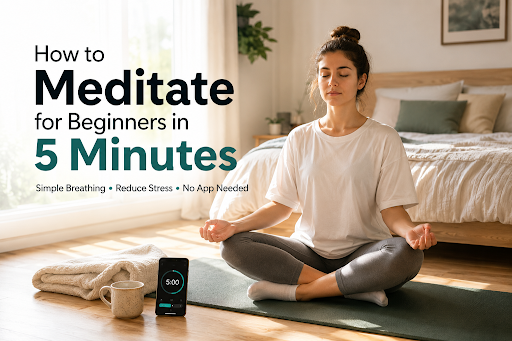
You’ve got five minutes before the kids wake up. Or before your shift starts. Or before that Zoom call you’re dreading. That’s the window, take it or leave it. So you type “how to meditate for beginners for 5 minutes” and get buried in apps, cushions, some guy on YouTube talking about “presence.” Skip it. Sit down. Set a timer for five minutes and just… don’t get up. That’s the whole trick. Nobody tells you breathing is easy it’s the sitting still that gets you. Why Five Minutes Is Plenty When You’re Starting Out Here’s what happens to most beginners. They pick a big goal, like twenty minutes a day. They sit down once. By minute six they’re bored and itchy. They never try again. I’ve done this myself. More than once. Five minutes doesn’t give you time to hate it. You can do it in your car before work. You can do it on the edge of your bed before your feet hit the floor.You can do this sitting on the edge of the bed, feet not even on the floor yet. You can do it in a bathroom stall if the day’s already falling apart by 9am. Nobody has to know you’re in there breathing instead of scrolling. There’s no minimum size for this to count. Five minutes on the edge of a mattress is the whole plan. How to Start Meditating in 5 Simple Steps Forget the teacher, forget the special room. Just find somewhere nobody’s going to knock on the door for five minutes.A chair, your bed, the floor, whatever you’ve got. Set a timer on your phone. That way you’re not peeking every thirty seconds to check the time. Sit up with your back fairly straight. Rest your hands on your legs. Close your eyes, or just look softly at the floor. Breathe like you normally do. No special trick yet. Just feel the air move in and out. Your mind’s going to wander. Fast. Probably to the grocery list, or something dumb someone said last Tuesday that you’re still chewing on for some reason. Doesn’t matter. Notice it, and drag your attention back to your breath. That’s it do that a hundred times if you have to. That’s the whole skill. Not clearing your mind. Just noticing it wandered and coming back. Again and again. If you already keep your workouts on a set schedule, treat this beginner meditation habit the same way. Same time. Same chair. Timer on. Done. That beats waiting to feel motivated. A Simple 5-Minute Breathing Exercise for Beginners Maybe “just breathe normally” feels too loose. Try this instead. Spend the first minute settling in. Take three slow breaths. Nothing fancy. For the next three minutes, breathe in for a count of four. Hold for four. Breathe out for six. The long exhale is what actually calms your body down, more than the counting itself. In the last minute, drop the counting. Breathe however feels natural. Sit for a bit before you open your eyes. Counting gives your brain a small job. Once the breathing thing feels normal, try a few others and see which one your brain actually takes to. Beginner Meditation Techniques Worth Trying Once the breathing version feels normal, try a few other beginner meditation techniques.Body scan is exactly what it sounds like. Start at your feet, move up slowly, head last. When you hit a tight spot, shoulders, jaw, wherever you’re clenched today just clock it. You’re not fixing anything. You’re just finding out where you’re holding tension without noticing. Counting breaths works well if you like having a number to hold. Count each breath out, up to ten, then start over. If you lose count at forty-seven, just laugh and reset. Nothing means you silently name a thought as it pulls you away. “Thinking.” “Planning.” “Worrying.” Then you go back to your breath. That’s really all it’s doing putting a little distance between you and whatever your brain’s up to. And if sitting still for five minutes sounds like torture, skip it. Walk instead. Walk slow. Feel your feet on the ground. None of these is the “right” one. Try each for a few days. Stick with whatever actually gets you to sit down again tomorrow. That’s the only metric that matters. Simple Meditation for Anxiety and Racing Thoughts Maybe your brain never shuts up. Twenty things going at once, none of them finished. Five minutes of quiet sounds like the last thing you’d want. That’s not you failing at this honestly it might mean you need it more than the person next to you who’s already calm. Loud brain day? Skip the breathing, try 5-4-3-2-1 instead. Name five things you can see. Just look around and count them off. Four you can touch. Three you can hear. Two you can smell. One you can taste. This pulls your mind out of the spiral and back into your body. That’s really what meditation is trying to do the whole time anyway. Your mind staying busy for the full five minutes is not failure. There was never a blank-mind goal. The National Center for Complementary and Integrative Health says meditation’s generally safe for healthy people. It’s also one of the more studied ways to deal with everyday stress. So that’s not nothing worth remembering on the days this feels more like a fight than a rest. The Best Time to Meditate When You’re New to It Mornings tend to work best. Your head isn’t yet jammed full of today’s garbage. Five minutes before you reach for your phone, and you have your calm baseline before the chaos begins. But truthfully, the ideal time is whatever window you’ll manage to carve out. Chaos reigning in your mornings? Give lunch a shot. Or five minutes once you’re in your parked car but not out on the road. I’d much prefer someone meditating at 6 p.m. every day over pursuing some “ideal” 6 a.m. time that they can