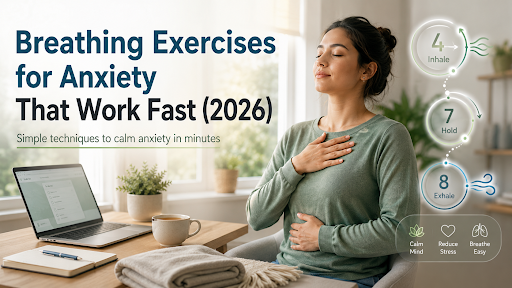
Picture this: you’re sitting in your car before a job interview, and your chest’s already tight, hands cold, maybe with a slight shake to them. Your brain’s already three disasters deep, and you haven’t even walked in the door yet. Anxiety does that. It shows up in your body first, not your thoughts. Took me way too long to figure that out myself. The good news is that breathing exercises for anxiety don’t need much to bring it back down just air, used on purpose. No app, no pills, nothing to buy. You’re already carrying the fix around with you, which honestly feels a little unfair given how much anxiety apps cost these days. So here’s the plan for this post. What to actually do. Why does your body respond to it at all. And how you actually turn it into a habit, not something you only remember mid-spiral. (If racing thoughts tend to show up alongside the physical symptoms, it’s also worth reading how anxiety and sleep feed off each other the two are more connected than most people realize. What Anxiety Actually Does to Your Breathing Your nervous system genuinely cannot tell the difference between a rude email and an actual bear. Same alarm either way short breaths, racing heart, tight shoulders and your whole body is basically shouting one thing at you: something’s wrong, deal with it. That’s your fight-or-flight response kicking in, which is fantastic news if there happens to be an actual bear involved. It’s less great for a Monday standup meeting or a text you’ve been avoiding for three days. Your body just hasn’t gotten the memo that most modern stress won’t kill you. Here’s the one thing that actually works in your favor, though: breathing is the part of this whole mess you can control. You can’t let your heart rate go down. Telling yourself to relax does nothing for sweaty palms. They don’t take orders. But breath listens. It’s the only lever in the whole system that answers when you pull it. How to Calm Anxiety Fast With Your Breath Here’s the whole trick, and I mean the entire thing: breathe out longer than you breathe in. That’s it. Sounds too simple to work. It works anyway.This single principle is the backbone of nearly every one of the breathing exercises for anxiety covered in this guid In through your nose for four seconds. Out through your mouth for six. Slow, like you’re fogging up a window on a cold morning. Do it for one minute just sixty seconds and most people feel a shift before the minute’s even over. The first time I tried it, I figured it was nonsense. Then I caught that my shoulders had already dropped; I hadn’t even asked them to. Why does a longer exhale do anything? That’s your vagus nerve switching on, the one that runs all the way from your brain down to your gut. Breathe out slowly, and that nerve sends one message down the line: stand down; we’re fine. The National Center for Complementary and Integrative Health backs this up. Too slow breathing is safe for most people and can genuinely help with stress and anxiety, not just make you feel like you’re doing something. The 4-7-8 Breathing Method This one’s Dr. Andrew Weil’s, and it’s probably the most Googled breathing technique for anxiety relief out there. There’s a reason. Dead simple, and it’s especially good for the nights your brain just won’t clock out at 11pm. Sit down or lie flat, whatever’s easier. Tongue touches the roof of your mouth behind your front top teeth. Take a deep breath out through your mouth without holding back on that whooshing sound; it’s meant to be heard. Close mouth, and inhale through nose for four counts. Hold for seven. Exhale through mouth for eight counts. One repetition. Start off with four repetitions. Heads up; your first repetition may make you feel a bit dizzy. Completely normal. Nothing to get worked up over. You won’t feel it after your body adjusts to the process. Some people swear by this one right before bed. Others use it seconds before a hard conversation walking into a breakup talk, a performance review, whatever. Same counts, every time, no matter what’s on the other side of it.If a racing mind at night is your main trigger, our breakdown of how anxiety keeps you up at night goes deeper into why this particular method tends to help. Belly Breathing You Can Do Anywhere Belly breathing or diaphragmatic breathing, if you want the fancier term might honestly be the most useful of the three, just because nobody watching you can tell you’re doing it. Hand on your chest. Hand on your belly. Breathe in through your nose and try to get the belly hand to rise more than the chest one. Hold for a second. The next step is to exhale through your mouth to enable your belly to relax completely. Many people usually breathe through their chests rather than engaging the lungs with proper deep breathing.Belly breathing pulls in more than that, and more air is basically a signal to your body that it can stand down. Do it for two or three minutes. In line at the grocery store. Stuck in traffic. Or standing outside a door you’d rather not walk through. Not glamorous, not exciting. Just works. Building a Daily Practice, Not Just an Emergency Fix Most people only pull out breathing exercises when things are already going sideways. Fair enough, that’s when you notice you need them. But the people who actually get results practice on the boring, nothing-is-wrong days too. Think of it less like a fire extinguisher and more like exercise for your nervous system. You don’t wait until your back is already thrown out to start stretching. Same idea here. Build the habit before the bad day shows up, so it’s already loaded when you need it. Five minutes in the morning is